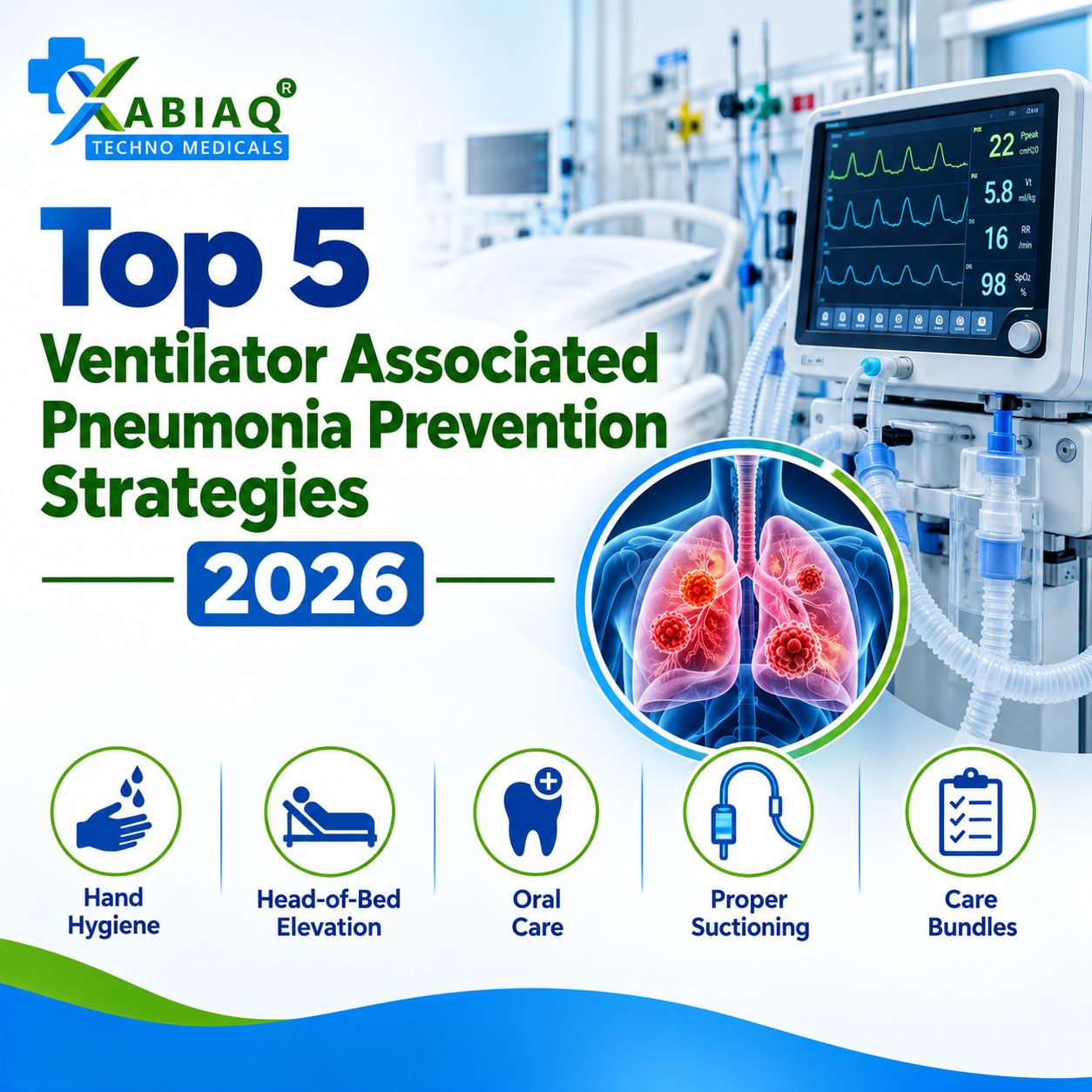
Top 5 Ventilator Associated Pneumonia Prevention Strategies 2026
By: admin
September 28, 2026
Ventilator-associated pneumonia (VAP) is an important issue in intensive care units (ICUs), especially in patients who are undergoing long-term mechanical ventilation. It can contribute to the length of hospitalization, the use of antibiotics, the length of ventilation and the costs of health care. Airway management strategies that can be used to prevent airway occlusion are crucial to patient safety and critical care management.Subglottic Suction Tracheostomy Tube is a device that will allow the removal of secretions from the area above the inflated tracheal cuff.
XABIAQ Techno Medicals offer medical technology solutions to healthcare facilities such as equipment for critical care and airway management needs.These tubes have an extra suction lumen which enables health care workers to draw out secretion before it can pool around the cuff. With proper patient monitoring, appropriate ICU protocols, and infection control measures, subglottic secretion drainage can be a component of a full VAP prevention strategy.
Understanding Ventilator-Associated Pneumonia
Ventilator-associated pneumonia is the infection of the lower respiratory tract after the introduction of microorganisms. ICU patients may suffer from a depressed ability to cough or breathe spontaneously, prolonged ventilatory needs, and other clinical conditions that make them vulnerable to respiratory infections.A conventional endotracheal tube or tracheostomy tube will have an inflated cuff that is used to keep the seal required for positive pressure ventilation.
Liquid from inside mouth, upper GI and sinuses may collect over the cuff, however. A small folding of the cuff material can permit contaminated secretions to go into the lower respiratory tract called “microaspiration”.This can lead to respiratory infections through aspiration of the bacteria-containing secretions. Traditional tubes with no special secretion drainage lumina may not offer a direct way of routinely draining secretions from the subglottic space.
Subglottic Secretion Drainage Technology
The subglottic secretion drainage (SSD) technology is intended to drain secretions above the inflated cuff of a tracheal tube. Endotracheal tubes and tracheostomy tubes with a secondary evacuation port are placed inside the wall of the tube, and have a suction opening that is located above the cuff.The suction port is for the healthcare professional to use to remove accumulated secretions by using regulated continuous or intermittent suction as per the instructions given on the device and according to the protocol followed in the ICU.
A dedicated suction connection is used on some systems or manual evacuation can be done on some systems as specified by the manufacturer. Modern Tube for Subglottic Secretion Drainage (SSD) takes into account the point of suction and protection of airway tissue. Adequate suction pressure, placement of appropriate tubes, cuff pressure monitoring and frequent evaluation are essential to minimize the potential for mucosal injury, and ensure adequate airway management.
Benefits of Subglottic Suction Tracheostomy Tubes
Subglottic Suction Tubes are an alternative way to deal with secretions for those who are on mechanical ventilation. The dedicated suction lumen removes contaminated secretions above the tracheal cuff that could decrease the amount of secretions available to microaspirate into the lower respiratory tract. Drainage of airway secretions may be continuous or intermittent and is useful in selected patients who will be on prolonged mechanical ventilation. It also can be used alongside regular airway suctioning and other respiratory care procedures.Subglottic suction drainage is an adjunct to existing ventilator care bundles, such as oral hygiene, cuff pressure management, head of bed elevation and periodic reassessment of ventilator needs, which has the potential to be used to help with ICU infection prevention.
Key Benefits
Reduced Microaspiration Risk: Prevents the build-up of contaminated secretions in the subglottic area which may enter the lower respiratory tract in some patients requiring mechanical ventilation.
Improved Secretion Management: Has a dedicated drainage lumen for routine, continuous or intermittent drainage above the cuff in addition to regular airway suctioning and respiratory care.
Support for VAP Prevention:When used in conjunction with oral hygiene, appropriate cuff pressure management, and other existing practices in the intensive care unit, contribute to the VAP Prevention protocols.
Better Airway Management: Allows secretion control in specific patients needing long duration of mechanical ventilation and continuous airway care.
Integration with ICU Care Bundles: Enables healthcare professionals to incorporate subglottic secretion drainage into comprehensive infection prevention and ventilator management procedures.
Potential Reduction in Treatment Burden:When used correctly as part of a comprehensive patient care plan, may help lower the risk of complications and treatment needed for VAP.
The benefits are, however, dependent on patient selection, device design, proper suction settings and application of ICU protocols. These tubes do not remove the risk of VAP nor do they supplant other infection control precautions
How to Choose Right Subglottic Suction Tracheostomy Tube
Choosing a tube depends on the patient's airway anatomy and need for ventilation, the length of time the patient will be intubated, and the clinical condition. A comparison of the sizes of the tubes, cuffs, suction lumen configuration, connectors, and availability of proper drainage options should be made between healthcare professionals.A suction port must be properly shaped to ensure secretion removal and to prevent harmful impacts on the mucous membranes.
Other items of interest to hospitals are the manufacturer's instructions for suction pressure, continuous or intermittent drainage, cuff pressure monitoring, and device replacement. Staff training and existing ICU equipment are of great importance.Healthcare providers must consider the quality of the products, sterile packaging, relevant regulatory paperwork, clinical assistance, and supply reliability when assessing Subglottic Suction Tracheostomy Tube Manufacturers in India. These factors can help the procurement team determine if the equipment will meet the hospital's airway management and infection control needs.
Applications of Subglottic Suction Tracheostomy Tubes
Subglottic suction tracheostomy tubes have been indicated for certain patients undergoing mechanical ventilation and require airway access. They are used as a clinical and anatomical choice, based on the patient's need for ventilation, and the clinical judgment of the treatment team.
Intensive Care Units (ICUs)
For selected patients who are going to require long-term mechanical ventilation, special suction tracheostomy tube can be utilized in ICUs. The extra lumen can facilitate the evacuation of secretion and may be incorporated into the unit's respiratory infection prevention practices.
Long-Term Mechanical Ventilation
If the patient will need prolonged ventilatory support, there can be continued accumulation of the secretions in the upper airway. If the patient and device are clinically appropriate, a subglottic drainage can be used as another way to control these secretions.
Critical Care and Airway Management
These tubes can be used to assist with airway management and ventilator monitoring, oral care, routine respiratory evaluation and other critical care tasks. Use of a specialized tube should be based on patient clinical needs and hospital policy.
Latest Trends in Critical Care Airway Management
The utilization of modern techniques of airway management is increasingly centered around the prevention of complications of prolonged mechanical ventilation. Evidence-based ventilator care bundles, structured oral hygiene protocols, frequent sedation assessment and early assessment of readiness to liberate from the ventilator are being adopted in the hospital setting.An additional development that was noteworthy was the integration of special airway devices with secretion drainage.
Subglottic suction technology offers a controlled way around the cuff to remove secretions above the cuff and allows for better structured airway secretion management.Also, the safety of the devices, training of staff, monitoring of the suction pressure and standardized protocols in the ICU are being highlighted in healthcare facilities. These measures contribute to the use of specialized airway equipment in standard critical care practice and have the potential to preserve patient individuality in the management of airway equipment.
Conclusion
This type of airway management for selected patients with prolonged mechanical ventilation is an important component of subglottic secretion drainage (SSTD). Specialized tracheostomy tubes are also designed to have a separate lumen for the drainage of secretions above the cuff, which can help minimize the risk of microaspiration and facilitate VAP prevention measures.The choice of appropriate equipment involves considering the size of the tube, the type of cuff, the lumen of the suction tube, safety features, and the clinical needs.
Subglottic suction should be combined with the existing infection control measures, airway management and frequent patient assessment. XABIAQ Techno Medicals provides medical technology solutions to healthcare facilities for modern clinical environments. Hospitals and critical care teams can review appropriate airways management devices that match their clinical needs, technical parameters and applicable medical standards.
(FAQs)
1. What critical care equipment does XABIAQ Techno Medicals provide?
XABIAQ Techno Medicals offers Medical Technology solutions to various healthcare institutions and practitioners for a variety of clinical, surgical and critical care equipment needs.
2. Why consider XABIAQ Techno Medicals for airway management equipment?
XABIAQ Techno Medicals aids medical equipment users in assessing medical equipment on technical specifications, intended clinical applications, and operational requirements.
3. What is a subglottic suction tracheostomy tube used for?
Subglottic Suction Tracheostomy Tube is used to suction the secretions above the inflated tracheal cuff in patients who have been selected for mechanical ventilation and airway support.
4. How does subglottic suction help prevent VAP?
Subglottic suction allows removal of mucus above the cuff, which may decrease the amount of contaminated material that is subject to microaspiration into the lower respiratory tract. It works with other preventive measures for VAP.
5. What should hospitals consider when selecting subglottic suction tubes?
Hospitals should consider factors such as cuff design, suction lumen configuration, device compatibility, sterile packaging, regulatory documentation, manufacturer instructions, and staff training considerations when considering tube size.