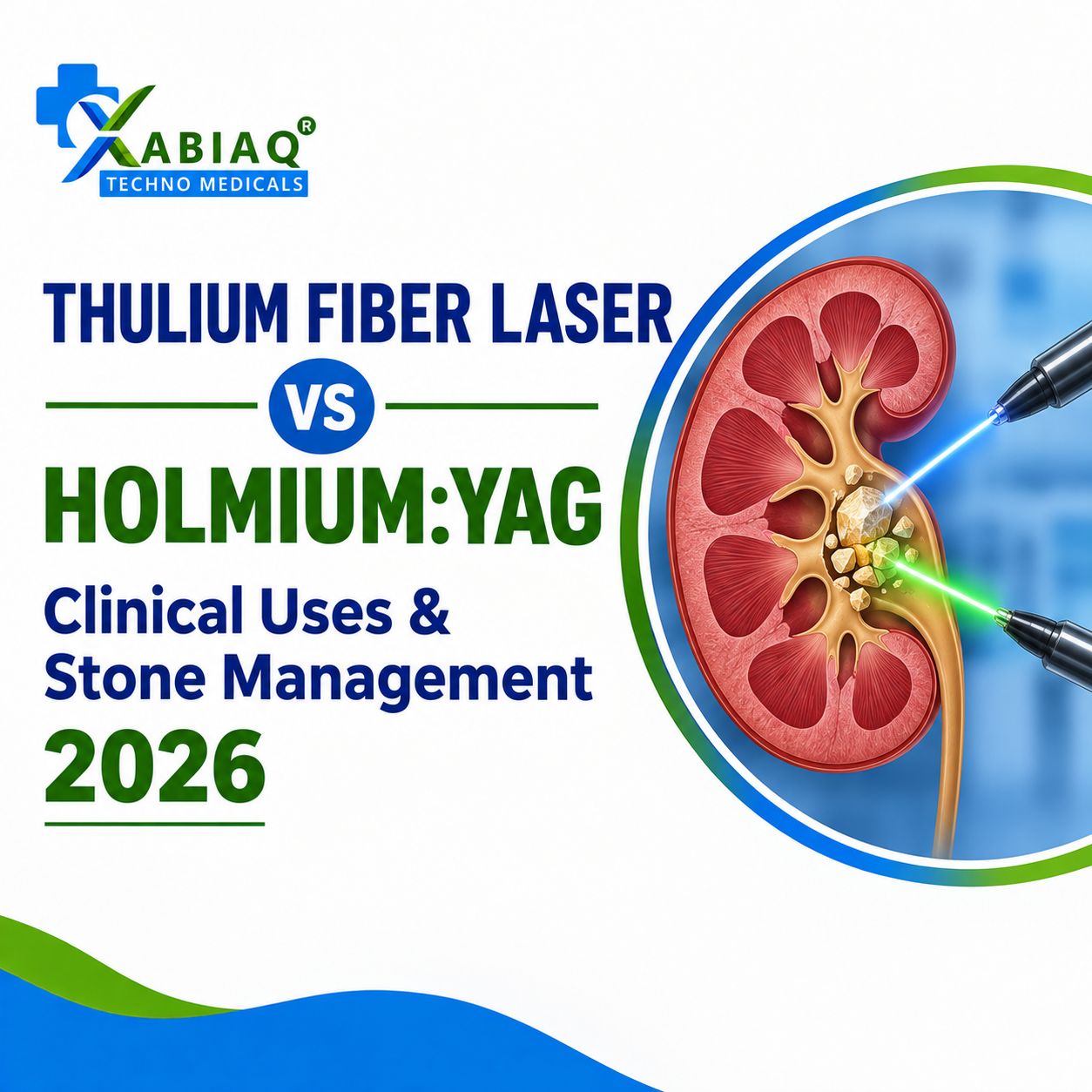
Thulium Fiber Laser vs Holmium:YAG Clinical Uses & Stone Management 2026
By: admin
September 28, 2026
The application of laser technology has revolutionized modern urology, and it is used in the diagnosis, treatment, and management of stones, as well as prostate treatment, which is done in a minimally invasive manner. The success of endourological procedures depends on energy delivery, effective fragmentation and controlled interactions with the stone and tissue to ensure procedural efficiency and patient care.The Thulium Fiber Laser (TFL) is a high-end laser technology suitable for thyroid surgery and special soft-tissue applications as well as for urinary stone therapy.
XABIAQ Techno Medicals is a medical technology solutions provider for clinical settings and medical professionals looking to acquire equipment for contemporary clinical uses.TFL has various characteristics when used in comparison with conventional Holmium:YAG laser platforms, such as higher repetition rates, lower pulse energy options, and compatibility with smaller laser fiber size. Depending on the clinical need and equipment specifications, these features have helped in the use of this in lithotripsy and prostate enucleation.
Problems in Conventional Endourological Procedures
There are challenges associated with stone fragmentation, extraction of fragments, and visibility in surgery in conventional stone management. Basket retrieval might be necessary for larger stone fragments, which will extend the number of instrument exchanges and procedure steps. Another issue is that of stone retropulsion, where the stone's fragments move away from the treatment area due to the laser energy.
This may make it more difficult to manage stones, especially during ureteroscopy, and could take longer to move the stone out of the way and treat it.Thicker laser fibers also can cause deflection of the scope and change irrigation flow when performing flexible ureteroscopy. Depending on the anatomy and the endoscopic equipment to be used, access to lower-pole renal stones may be more difficult because of these limitations.
Advancements in Thulium Fiber Laser Technology
Thulium Fiber Laser (TFL) is a strong water absorber, at around 1940 nm, with a greater water absorption than Holmium:YAG lasers that operate close to 2100 nm. This enables small energy delivery to break urinary stones and soft tissue treatment. In some systems, TFL can allow for high repetition rates up to 2000 Hz or more with minimal pulse energy, allowing for ultra fine stone dusting and potentially eliminating basket extraction and retropulsion in some instances.
One other major development is the addition of smaller (150 µm and 200 µm) laser fibres, which may help preserve the flexibility of the ureteroscope deflection and improve the space for irrigation during lower-pole laser procedures. These properties make Thulium Fiber Laser Technology applicable to contemporary endourology, and the treatment parameters and results for use depend on the stone composition, the equipment being used and the surgical skills.
Benefits of Thulium Fiber Laser Technology
Thulium Fiber Laser technology provides for efficient fragmentation of stones with adjustable pulse energy and high repetition rates. Some renal and ureteral procedures may benefit from fine dusting which can lessen the need for repeated basket extraction. Smaller laser fibers also help maintain flexibility of the urosthrope, and facilitate access to difficult stones and allow more room for irrigation during lower-pole procedures.
Key Benefits:
Highly efficient fragmentation of stones and fine dusting.
Minimised multiple basket removal.
Better flexure deflection of the ureteroscope.
Improved approach to lower pole renal stones.
Controlled coagulation of tissues during prostate procedure.
Hemostasis and visibility for enucleation and evaporation.
The characteristics of Thulium Fiber Laser Technology are effective for the application in modern endourology and certain prostate procedures. The actual results vary as a function of stone composition, laser settings, equipment specifications and surgical technique.
How to Choose Right Thulium Fiber Laser System
The key factors to consider when choosing a laser platform are based on the urology workload, stone management needs and anticipated number of procedures in the hospital. A comparison of the available energy, repetition rate, mode of operation and wavelength should be made between the various options available to the buyer when considering the clinical use.
Depending on the system used, the buyer should make sure that the system has the appropriate fiber diameters, such as 150 µm or 200 µm, as well as that these are compatible with their flexible ureteroscopes. Irrigation needs, safety and maintenance should also be evaluated.Healthcare institutes need to consider technical documentation, relevant certifications, installation assistance, clinical training, and post-sales support while comparing the Thulium Fiber Laser Manufacturers in India. These considerations are important for hospitals to determine if a laser platform is suitable for their endourology and stone management needs.
Applications of Thulium Fiber Laser in Urology
Thulium Fiber Laser technology is being utilized across a broad range of endourology applications for urinary stone treatment including ureteroscopy andRetrograde Intrarenal Surgery (RIRS). It works at high frequency and can be used for fine dusting of renal and ureteral stones, which leads to smaller pieces that can potentially decrease the need for repeated basket extraction. Treatment choices depend on the stone composition, size, stone location, and surgeon's preferred treatment approach.The procedure will be determined by the indications and anatomy of the prostate, the nature of the stones, equipment specifications and the surgeon's experience.
Key Applications:
Intracorporeal Lithotripsy:Assists in fragmentation and dusting of stones within the urinary tract during URS and RIRS procedures with the possibility of minimizing mechanical stone extractions in some instances.
Thulium Fiber Laser Enucleation of the Prostate (ThuLEP):Assists in the separation and removal of enlarged prostate tissue without interfering with the anatomical plane, and provides coagulation and operating visibility when treating benign prostatic hyperplasia (BPH).
Thulium Laser Vaporization (ThuVEP):Vaporizes tissue blocking urination and coagulates small blood vessels to treat certain cases of BPH.
There are applications that utilize Thulium Fiber Laser Technology in today's stone management and in selected prostate surgeries where treatment results and recovery vary depending on each patient's condition and surgery technique.
Latest Trends in Endourological Laser Technology
New endourological laser systems are increasingly being available that provide a range of pulse settings and repetition rates as well as fiber type compatibility. Given the developments, there are various methods of stone fragmentation, such as controlled fragmentation and fine dusting.One trend is to use smaller fibers, and flexible ureteroscopes.
This can be helpful in procedures for accessing renal stones, which may be difficult to reach.Thulium laser uses are progressing beyond soft-tissue applications, and now involve prostate enucleation and vaporization procedures. Healthcare systems are looking for laser systems that meet service needs over the long term, are safe, and offer versatility in terms of procedures.The versatility of procedures, equipment safety, training, and long-term service requirements are being assessed for laser systems in healthcare.
Conclusion
The selection of an appropriate laser system should take into account clinical applications, fiber compatibility, energy levels, safety features, and technical support.Thulium fiber and Holmium YAG lasers have different technical characteristics that influence their applications in endourology. TFL has a high number of repetitions, smaller fibres and excellent water absorption, which makes urinary stone fragmentation and certain prostate procedures possible.With careful evaluation, healthcare facilities are able to recognize the equipment that fits their endourology and stone management requirements. XABIAQ Techno Medicals assists health care professionals with medical technology solutions in today's clinical environment. Hospitals and urology centers have the opportunity to assess the appropriate laser platforms based on their procedure needs and technical attributes.
Frequently Asked Questions
1. What urology laser solutions does XABIAQ Techno Medicals provide?
XABIAQ Techno Medicals offers medical technology solutions to healthcare facilities and medical equipment options for various clinical and surgical needs.
2. Why consider XABIAQ Techno Medicals for medical laser equipment?
XABIAQ Techno Medicals assists healthcare providers in medical equipment assessments based on technical requirements, clinical use and operational needs.
3. What is the difference between Thulium Fiber Laser and Holmium:YAG?
Thulium Fiber Laser is used around 1940 nm and has high repetition rate and low pulse energy dusting capability. Holmium:YAG works at approximately 2100 nm, and has already proven its place in urinary stone fragmentation and soft-tissue surgeries.
4. What is TFL used for in endourology?
Thulium Fiber Laser for Lithotripsy is intended for selected ureteroscopy and RIRS procedures for the fragmentation of urinary stones. It can also be used for a few prostate applications such as ThuLEP and ThuVEP procedures.
5. What should hospitals consider when selecting a Thulium Fiber Laser?
Hospitals should evaluate the following parameters: pulse energy, repetition rate, fiber compatibility, safety, certification, training, and technical support, depending on their stone management and prostate treatment needs.