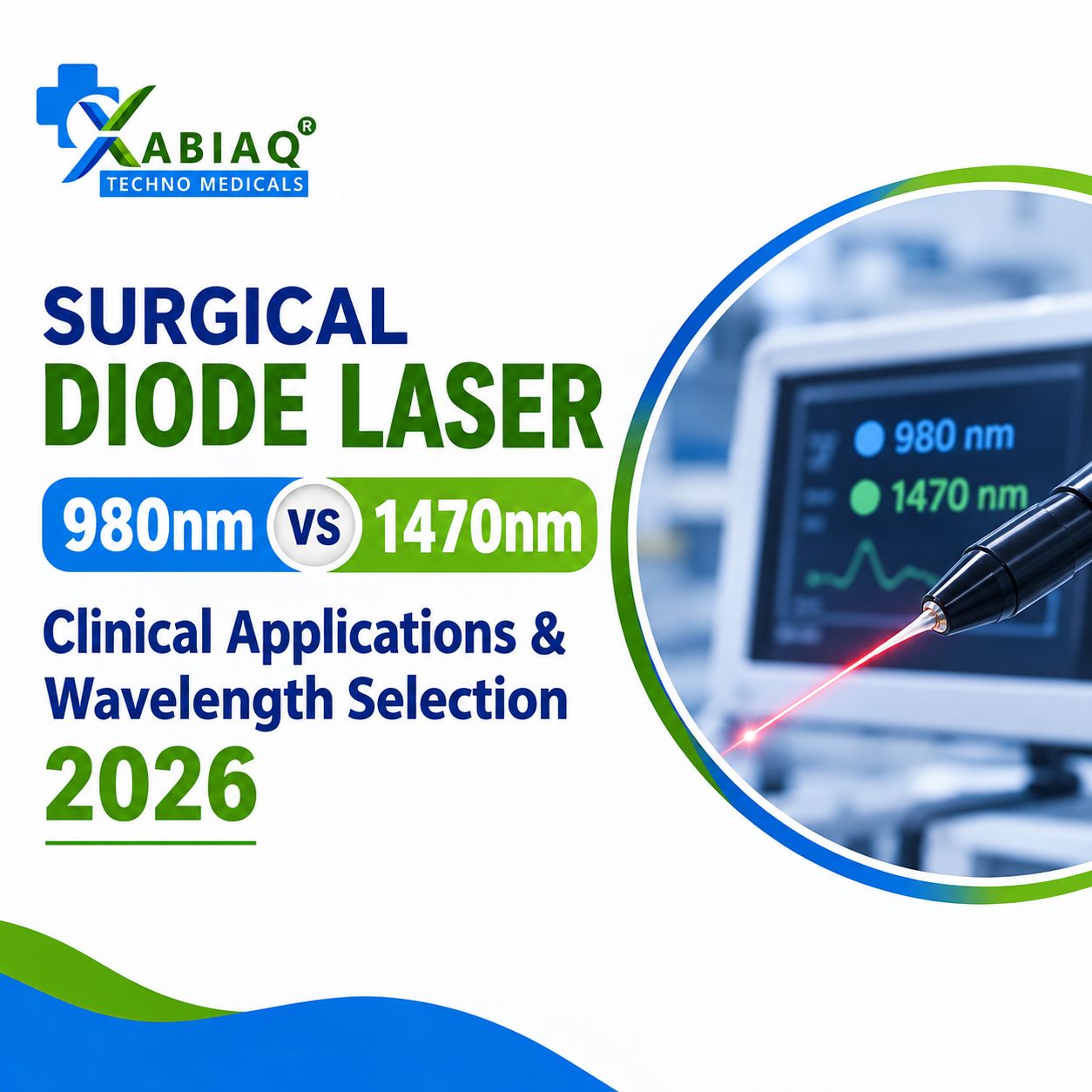
The minimally invasive surgery has changed modern day-care surgical units by providing alternatives to conventional surgical excision. In proctology, vascular surgery, gynecology and other specialties of medicine, laser technology is used for controlled cutting, coagulation and ablative action of tissues. Choosing the right wavelength is critical for energy delivery, tissue interactions, and precision in surgical procedures.A surgical diode laser is an incredibly popular laser in medicine today that can be used for soft-tissue treatment and coagulation.
XABIAQ Techno Medicals supports the medical sector with laser technology solutions designed for different clinical requirements.the commonly used wavelengths, 980 nm and 1470 nm have different tissue absorption characteristics. It is helpful for surgeons and healthcare facilities to understand these differences when assessing laser platforms to determine which ones are appropriate for their procedures, treatment needs and clinical protocols.
Problems in Conventional Surgical Procedures
The surgery may require incisions, stitches and open wounds depending on the procedure. These methods can involve meticulous control of bleeding and monitoring of the wound in proctology and vascular surgery. The recovery period and discomfort experienced may be different depending on condition, surgical approach and individual patient.Another difficulty is regulating the heat around the treatment location.
If too much energy is used or the wrong wavelength is chosen, there is a risk of unwanted heating of the surrounding tissues. This can be a concern with laser-assisted procedures when controlling the energy, selecting the appropriate fiber, and surgical technique are important.For day care surgery, facilities must also have equipment that can be used for a variety of clinical applications yet still meet the requirements for the procedure.
Understanding 980nm and 1470nm Wavelengths
Laser energy to biological tissue interaction is related to the absorption properties of water and hemoglobin. These chromophores can affect the absorption and conversion of laser energy into heat, and therefore their effects on the cutting, coagulation and ablation of tissue during surgery.The 980 nm is effective in absorption in hemoglobin and water, it is suitable for coagulation, hemostasis and controlled soft tissue cutting.
It can be used in vascular procedures with proper power settings and delivery fibers to achieve a seal of the vessels and bleeding control.In watery tissues, however, the 1470 nm will have much higher water absorption, and thus the energy will act more superficially in watery tissues. This aids in controlled tissue vaporization and coagulation and helps to minimize unwanted thermal effects. They offer a single console which can deliver both the 980nm and 1470nm wavelengths on the same platform, enabling surgeons to choose the appropriate wavelength as per the procedure and clinical need.
Benefits of Surgical Diode Laser Technology
There are a number of potential benefits that can be gained from laser-assisted procedures if the right equipment and procedures are used. These benefits are dependent on the clinical indication and surgeon experience, patient condition and type of laser system.The clinical outcomes continue to depend upon proper patient selection, device settings and existing medical protocols.
Controlled Coagulation and Hemostasis
In soft-tissue procedures, laser energy may aid in coagulating small blood vessels. The 980 nm wavelength is suitable for applications where the absorption of hemoglobin and bleeding control is a concern.
Controlled energy delivery can increase visibility in the operative field and enhance the procedural efficiency. But the hemostasis must be appropriate to the power settings, fiber motion and tissue reaction.
Minimally Invasive Treatment Options
Laser fibers can be used to deliver energy in selected proctology and vascular procedures without having to make large incisions in the tissue. This could help to reduce the size of the wounds and help to support day-care treatment approaches.
Specific applications that use lasers for the treatment of specific tissues with minimal disruption of neighboring tissues include laser hemorrhoidoplasty and endovenous laser ablation.
Versatile Clinical Applications
A multi-wavelength platform can be used for multiple procedures because it provides more than one wavelength and can accommodate various delivery accessories. This flexibility can be beneficial for healthcare units that conduct a wide range of surgical procedures, such as general surgery, proctology surgery, vascular surgery or some aesthetic surgery.
How to Choose the Right Surgical Diode Laser
The appropriate system will depend on the clinical specialties, wavelengths needed and the anticipated number of procedures conducted at the healthcare facility. When choosing, buyers should consider the different wavelengths, output power, operating modes and compatibility with surgical fibers that are available.980 nm systems can be considered depending on the type of tissue interaction for facilities conducting procedures that involve coagulation.
1470 nm systems can be considered for water targeted applications like selected proctology and endovenous. Both are available with multi-wavelength systems, depending on device capabilities and clinical needs.Healthcare providers must also consider equipment certifications, operating safety features, service support, training, and compatibility of fibers when choosing Surgical Diode Laser Manufacturers in India. These factors should be used as a guide to help facilities determine whether a laser platform is appropriate for their specific clinical purposes.
Applications of Surgical Diode Lasers
The surgical diode laser is applied in various fields of medicine such as proctology, vascular surgery, ENT and aesthetic medicine. The choice of wavelength, fibre design and energy levels will depend on the particular clinical procedure and tissue to be treated.Laser hemorrhoidoplasty (LHP) is applied in selected cases of grade II and III hemorrhoids, to inject energy into the hemorrhoidal cushion and reduce the size of the tissue. Fistula-in-ano ablation (FiLaC) is another technique that involves applying a laser beam to gently heat the circumference of the fistula tract, trying to maintain the anal sphincter intact.
There is a need for proper selection of patients and surgical planning in both procedures.Endovenous Laser Ablation (EVLT) is used in vascular surgery when superficial venous reflux (SVR) in selected cases such as saphenous vein insufficiency is present. A good radial fiber that provides energy at 1470 nm is directed at the vein wall to encourage closure, and can help minimize bruising and unnecessary tissue damage than some of the older laser-fiber combinations. Surgical Diode Laser Applications also may be available for certain ENT, general surgical and aesthetic procedures, depending on the system's specific capabilities and approved indications.
Latest Trends in Surgical Diode Laser Technology
Contemporary surgical laser systems are being developed to offer the surgeon flexibility in selecting wavelengths, delivering controlled energy and availability of various delivery fibres. Multi-wavelength consoles give healthcare facilities a chance to consider one console for multiple procedures.Furthermore, improvements in the way energy is controlled, as well as the miniaturisation of console designs, are significant advances in laser-assisted surgery.
The features can be useful for controlling distribution of energy and practical applications for day-care surgical settings.Hospitals are also focusing more on device safety, training of users, device maintenance and technical support. Minimally invasive procedures are constantly evolving, and equipment that is selected is not only based on clinical needs but also on longer-term operational needs.
Conclusion
The characteristics of the absorption of 980 nm and 1470 nm wavelength light are different and affect the use of these wavelengths in modern surgical practices. The 980 nm wavelength is used in hemoglobin-oriented coagulation and 1470 nm wavelength has greater absorption by water and will be used in the selection of soft tissue and vascular treatments.There are many factors to consider when selecting the system such as the specialty clinic, procedure to be performed, type of fibers, safety and energy delivery.
If these factors are assessed properly, it enables healthcare facilities to select the appropriate equipment for their surgical operations.XABIAQ Techno Medicals offers medical technology solutions for medical professionals and medical facilities. Healthcare professionals may assess appropriate laser platforms based on their need for procedures, technical features, and medical regulations.
(FAQs)
1. What surgical laser solutions does XABIAQ Techno Medicals offer?
XABIAQ Techno Medicals offers medical technology solutions to healthcare professionals such as surgical laser products for various clinical needs.
2. What should buyers consider when selecting 980nm 1470nm Surgical Laser Systems?
Customers should consider the wavelength, output power, fiber compatibility, safety, certifications, training and after-sales technical support.
3. What are the applications of a Surgical Diode Laser?
Depending on the wavelength and the device, a Surgical Diode Laser is applied in selected proctology, vascular surgery, ENT, general surgery and aesthetic surgery.
4. What is the difference between 980 nm and 1470 nm surgical lasers?
The 980 nm wavelength has been used for coagulation and hemostasis and the 1470 nm wavelength has greater water absorption and is employed in selected soft-tissue and vascular applications.
5. Why choose XABIAQ Techno Medicals for surgical laser equipment?
XABIAQ Techno Medicals provides medical equipment solutions to the healthcare facilities based on technical specifications, clinical applications and procedural needs.